All case studies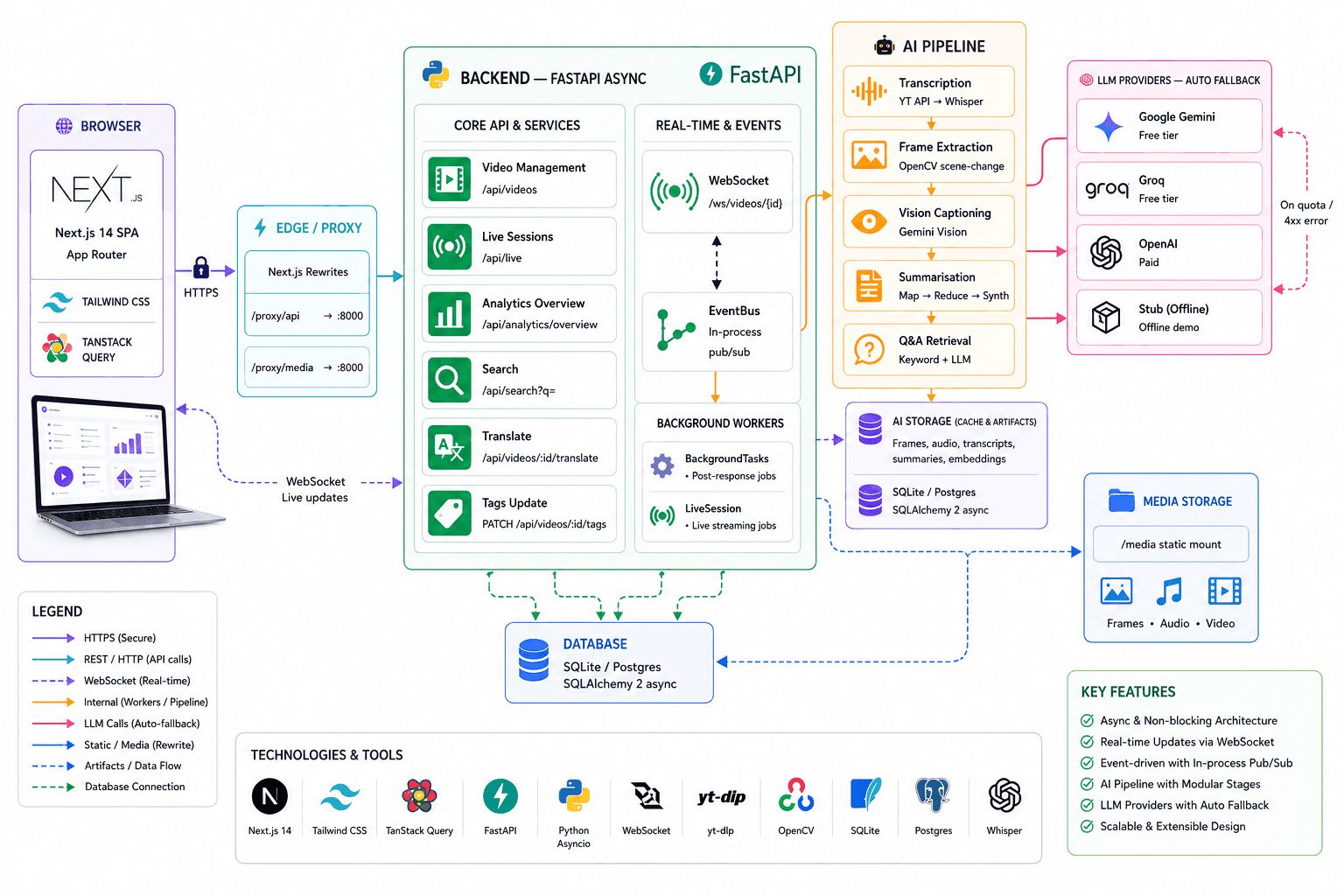
2026
VidIQ - AI Video Intelligence
Multimodal platform that turns any YouTube URL or live stream into a queryable transcript, keyframe analysis, timestamped summary and grounded Q&A. Runs end to end on free-tier infrastructure at $0 a month.
- Running cost
- $0/mo
- LLM providers with failover
- 3
- App routes
- 9
Stack
- Next.js
- TypeScript
- React
- FastAPI
- Python
- SQLAlchemy
- PostgreSQL
- Google Gemini
- Groq
- OpenAI
- faster-whisper
- OpenCV
- yt-dlp
- WebSocket
- Docker
- Tailwind CSS
Problem
A long video is opaque: you cannot search it, skim it, or ask it a question. VidIQ converts speech, vision and structure into one queryable artefact so a viewer can jump straight to what matters.
Architecture
Next.js App Router frontend -> FastAPI service -> provider-abstracted LLM, vision and transcription adapters -> SQLAlchemy over SQLite in dev and PostgreSQL in production, with an in-process event bus fanning pipeline progress out over WebSocket.
What it does
- Recorded pipeline: YouTube URL to metadata, transcript, scene-change keyframes, vision captions, then a multimodal summary
- Live pipeline: chunked download with rolling transcription, vision and LLM summarisation as the stream runs
- Provider-agnostic LLM layer that rotates across Gemini, Groq and OpenAI, so one quota denial is invisible to callers
- Retrieval-grounded chat where every citation seeks the embedded player to the exact moment
- Cross-library analytics, side-by-side comparison of analyses, tagging and 11-language transcript translation
Challenges & learnings
- Wrapped every external dependency behind an adapter with a configurable provider chain, so a quota error rotates to the next model rather than surfacing as a failure.
- Map-reduce summarisation over ~4500-character transcript windows keeps long videos within context limits while still producing one coherent overview.
- LLMs return JSON wrapped in markdown fences or as arrays where objects were expected; a defensive parser strips fences and finds the first balanced block rather than trusting the response shape.
- Split hosting across Vercel and Hugging Face Spaces because Spaces does not sleep idle containers and offers the RAM that Whisper, OpenCV and ffmpeg need.