All case studies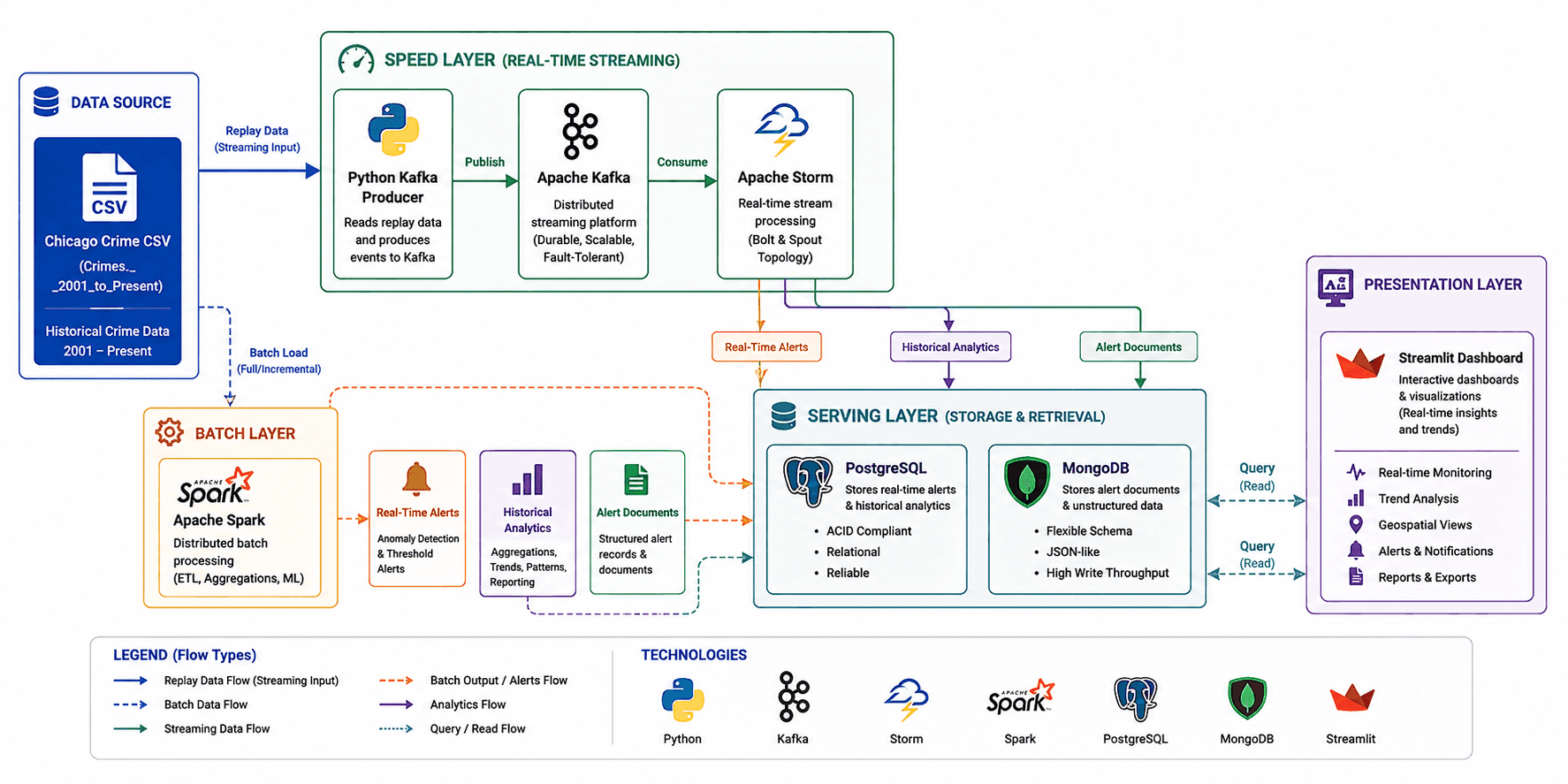
2026
Real-Time Crime Analytics - Lambda Architecture
End-to-end big-data system over Chicago open data: Spark recomputes batch views into PostgreSQL while Kafka and Storm detect district-level anomalies in a sliding window, both surfaced through one Streamlit dashboard.
- Source datasets joined
- 5
- Orchestrated services
- 7
- Serving stores (SQL + document)
- 2
Stack
- Apache Spark
- Apache Kafka
- Apache Storm
- PostgreSQL
- MongoDB
- Streamlit
- Docker
- Python
- Java
- PySpark
- K-Means
- SQL
Problem
City-scale crime data is large, continuously updated, and asked both strategic questions (long-horizon trends, hotspots) and tactical ones (unusual bursts). A Lambda architecture answers both without one compromising the other.
Architecture
Spark batch job -> PostgreSQL analytics tables. Kafka replay -> Storm topology -> PostgreSQL alerts plus MongoDB alert documents. Streamlit reads both stores.
What it does
- Batch layer in Spark: typed ingest, cleaning, time-trend aggregation, arrest-rate joins and K-Means geospatial hotspots written to PostgreSQL
- Speed layer in Kafka and Storm: sliding-window counts per district with a threshold anomaly test
- Dual serving stores, PostgreSQL for relational alert rows and MongoDB for raw alert documents
- Streamlit dashboard reading both paths so batch and streaming appear as one system
- Whole stack orchestrated by a single Docker Compose file: ZooKeeper, Kafka, Storm, Spark, PostgreSQL, MongoDB and the dashboard
Challenges & learnings
- Explicit StructType schemas mean malformed CSV rows land in _corrupt_record instead of silently shifting columns, which is the failure mode that makes bad analytics look fine.
- Alerts stayed empty against a live producer because the anomaly threshold was tuned for aggregate volume while traffic split across districts; the fix was a shorter window and a lower per-district threshold.
- Resubmitting a Storm topology consumed nothing because the superseded instance still held the Kafka consumer group on a single partition.
- The sex-offender extract has no district key, so rows are assigned deterministically by hashing the block. Documented as a relative signal rather than presented as a real geospatial join.